The Vow Renewal 💒
A Clipp Kaili original story
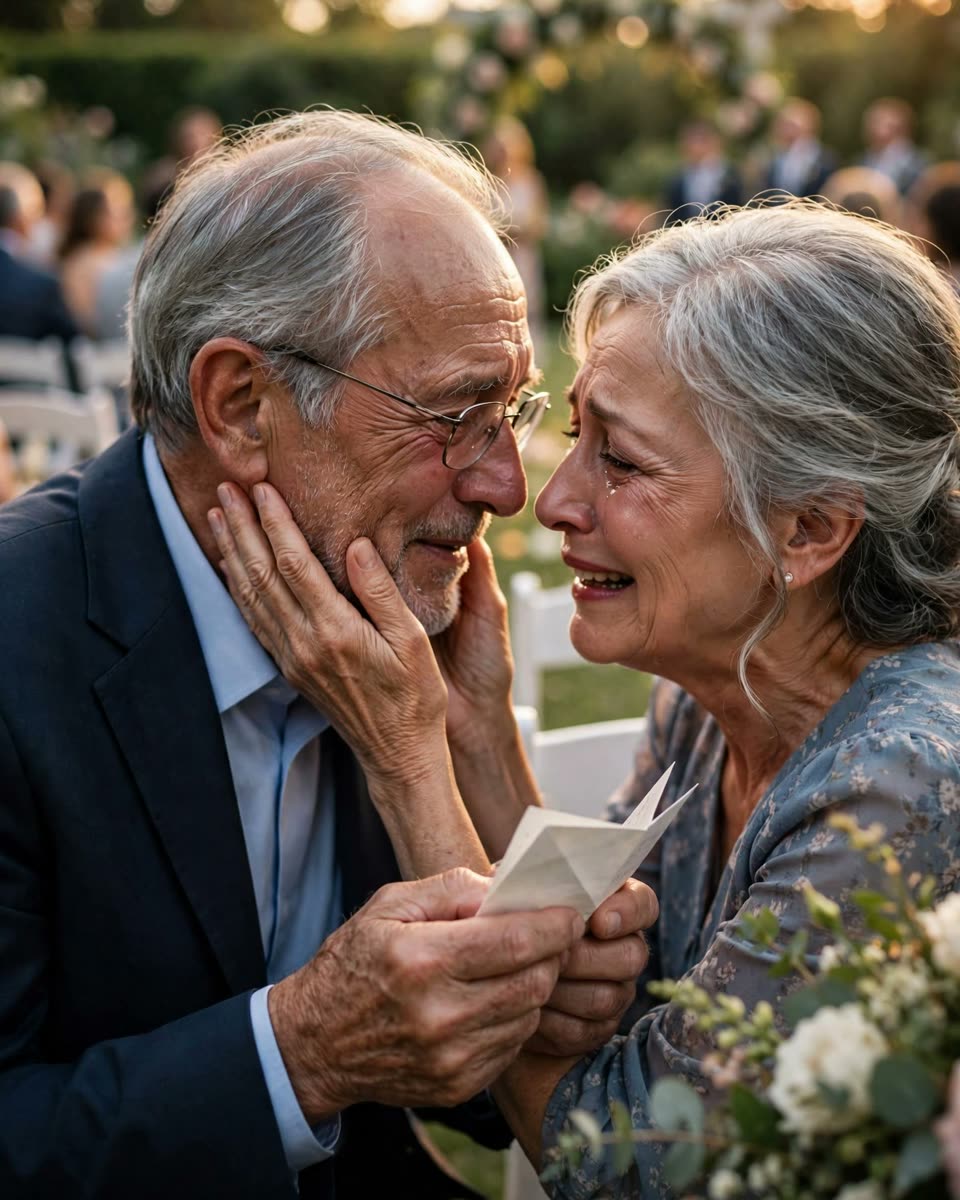
My father forgot my mother's name. In front of eighty guests.
It was their fiftieth anniversary. The vow renewal was Mom's dream — she'd been talking about it for years, ever since their friends the Callahans did theirs. A garden ceremony, white chairs in rows, string lights, all of us there. "Fifty years, baby," she'd say to Dad, beaming. "We earned a party."
Dad had early dementia. We all knew. The doctor had said it plainly six months before: "Good days and bad days. More good than bad, for now. Celebrate the good ones."
We planned the whole thing around Dad. Short ceremony — fifteen minutes, tops. Big print on everything. My brother James would stand next to him the whole time, just in case. Mom insisted Dad walk her down the little garden aisle himself. "He walked me down the aisle in 1976," she said. "He's doing it again."
That Saturday was supposed to be a good day. The morning was perfect — Dad was clear, joking with the caterer, telling the story about how he proposed in a rainstorm. Mom got ready at my house, and when I zipped up her dress — ivory, simple, elegant — she looked at herself in the mirror and whispered, "Seventy-three years old, and I'm still nervous."
"You look beautiful, Mom."
Dad looked handsome in his navy suit, the one we'd bought together, the one he kept calling "my wedding tux" no matter how many times we corrected him. Mom glowed. My brother and I stood up front with them. Eighty friends and family filled the white chairs — people who'd known them fifty years, people who'd watched this whole love story unfold.
The officiant — an old friend of Dad's — smiled at them and nodded. "Robert, please repeat after me. I, Robert..."
Dad opened his mouth.
Nothing came out.
He looked at Mom. He looked at the guests. He looked at me, and I saw it happen — the panic rising, the blank white wall coming down where the words should be. His hands started to shake.
"Sweetheart," Mom whispered, reaching for him, "it's okay, we can—"
But Dad shook his head. Tears were running down his face, and he didn't wipe them. "I know you," he said to Mom, desperate. "I know I know you. Don't go. Please don't go."
Eighty people held their breath. Someone's chair creaked. A baby fussed and was hushed.
My brother James stepped forward. In his jacket pocket, he'd put something that morning — something he'd found in the attic the week before, in a shoebox marked "1968" in Mom's handwriting, buried under Christmas ornaments.
Dad's original handwritten vows. Fifty years old. The ink faded to brown, the paper soft as fabric.
James unfolded them carefully and held them where Dad could see, his arm steady around our father's shoulders.
"Read with me, Dad," he whispered. "Just read."
And Dad — my father, who couldn't remember his wife's name — looked down at those fifty-year-old words, and something lit up behind his eyes. Something old. Something deep.
"I, Robert," he read, haltingly, one word at a time, "take thee, Margaret..."
The garden erupted — crying, laughing, crying again. Mom was sobbing into her bouquet.
He made it through three lines. Then he stopped. He looked up from the paper. He looked at Mom — really looked at her, the way he must have looked at her in 1976.
And he reached into his own pocket, and pulled out a folded piece of paper.
Nobody knew he could still write. His hands shook so hard James had to steady them as he unfolded it.
The paper was a grocery receipt — milk, eggs, bread on one side. On the back, in big, shaky, childlike letters, the letters wandering uphill like they were climbing, Dad had written four lines.
He held it up. The whole garden went silent. And he read, slowly, every word an enormous effort, his voice cracking:
"Margaret.
"I may forget your name.
"I will never forget you are mine.
"— Robert."
Mom made a sound I'll never forget — half laugh, half sob, pure heart. She took his face in both her hands and kissed him, right there, in front of eighty guests, in front of God and the string lights, like they were twenty-five again and the whole life was still ahead of them.
The applause went on for minutes. The officiant was crying into his notes. I was crying. James was crying. The caterer was crying.
Mom didn't let go of Dad's hand for the rest of the day.
Later that night, after everyone left, Mom told me the rest. Dad had been working on that note for three weeks. She'd find him at the kitchen table at midnight, tongue between his teeth like a little kid, writing and rewriting on the backs of receipts and envelopes. "He'd show me," she whispered, "and I'd say 'that's beautiful, Robert,' and the next night he'd try again, because he wanted it to be perfect."
"It was perfect, Mom."
"I know, baby." She looked down at the receipt, now carefully pressed in her Bible. "He forgot my name in front of eighty people. And then he told the whole world he'd never forget me."
Dad's dementia got worse after that day. There were more bad days than good, and the good ones got shorter. But Mom kept that grocery receipt in her purse until the day she died, two years later. She'd show it to anyone who'd look — the cashier, the nurse, strangers on the bus.
"See?" she'd say, holding it like treasure. "He forgot my name. But he never forgot me."
That's the thing about love, I think. It's not in the memory. Memory is just the filing cabinet. Love is deeper than that. It's in the bones. It's in the hands that shake and write anyway.
This story is a work of fiction, written to touch hearts and bring families closer.
← Back to all stories