The Snowstorm ❄️
A Clipp Kaili original story
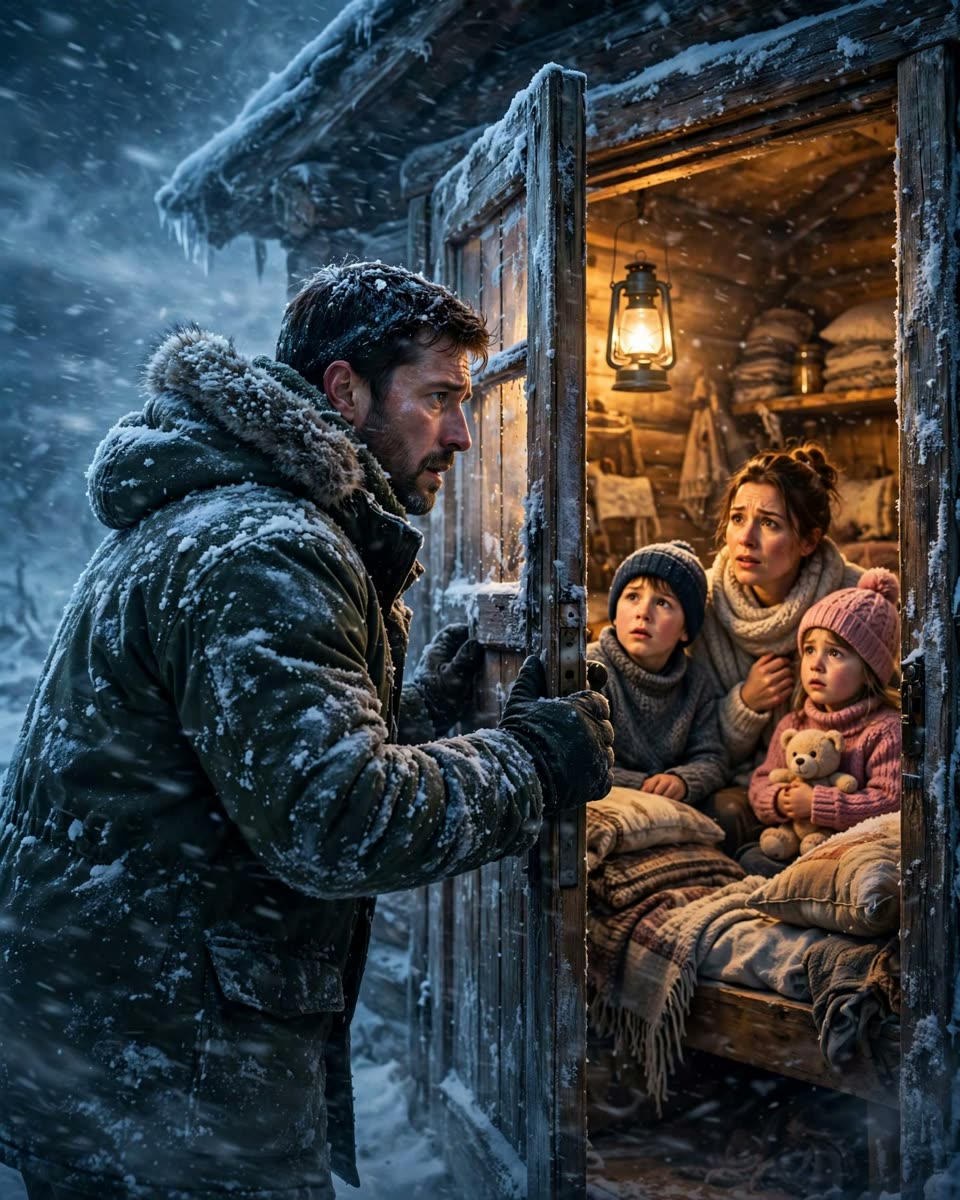
My father walked out into the blizzard. And closed the door behind him.
I was ten. It was December, the week after Christmas, and we were at our cabin in the mountains — Mom, Dad, my little sister Katie, who was four, and me. The cabin was Dad's pride: he'd built the porch himself, stocked the pantry, hung a sign over the door that said "THE MILLER HIDEOUT." We'd been coming every winter since I was six.
The storm came out of nowhere. One minute it was snowing lightly — the pretty kind, the Christmas-card kind — and the next, the world was white and screaming. The wind found every crack in the old cabin and whistled through them. The power went out at 4 p.m. with a sound like a sigh. By 6, the temperature inside was dropping, and our breath was coming out in little clouds.
Then Katie got sick.
It started as a cough. Then the fever — 103 on Dad's old thermometer, then 104. She was burning up and shivering at the same time, her little face so red it scared me. She kept crying, "Mommy, it hurts, make it stop," in this thin, reedy voice I'd never heard from her.
Mom wrapped her in every blanket we had. We had no medicine — we'd used the last of the children's fever reducer in November and never restocked. The car was buried to the windows. The phones were dead — the storm had taken the lines down an hour before the power.
Dad stood at the window for a long time, watching the white. Just watching. His reflection in the glass was the calmest thing in the room, and that scared me more than the storm.
Then he turned around, and his face was... calm. Too calm. The kind of calm that means a decision has already been made.
"I'm going for help," he said.
Mom grabbed his arm so hard her knuckles went white. "David, no. You'll die out there. People die in storms like this."
"The ranger station is six miles," he said. "Down the mountain road. Katie needs a doctor, Linda. A real one. With medicine."
"Wait until morning!" Mom was crying now. "Please. We'll keep her warm. We'll—"
"Morning might be too late." He said it gently. That was the worst part — how gentle he was.
He put on every layer he owned: thermal underwear, two sweaters, his ski jacket, two pairs of socks, his boots, his gloves, his hat, a scarf wrapped twice. He looked like a snowman. Katie, half-delirious, giggled weakly. "Daddy looks funny."
He knelt by her blankets and kissed her burning forehead. "Be good for Mommy, ladybug."
He hugged Mom so hard she cried into his jacket. He ruffled my hair — hard, the way he always did — and said, "Take care of them, champ. You're the man of the cabin until I get back."
Then he opened the door.
The wind screamed in, full of ice and fury, and the cold hit us like a wall. He stepped out into the white — I could barely see him, just his shape, getting smaller.
And closed the door behind him.
Mom threw the lock — the wind would have torn the door off otherwise — and we sat in the dark, listening to the storm try to kill our father. The cabin groaned. The windows rattled. Katie whimpered in her sleep, and Mom held her and prayed out loud — real praying, desperate praying — which she'd never done in front of us before. I stared at the door until my eyes burned.
Hours passed. I don't know how many. Time did something strange that night — stretched and snapped.
At dawn, the storm broke all at once, like someone turned off a tap. Sunlight poured through the windows. And there was pounding on the door — weak, but pounding.
Dad stood there, covered in ice, his eyebrows white, his face bloodless, his fingers blue-gray. Behind him, a ranger with a red medical kit.
He'd made it. Six miles. In a blizzard. In the dark.
Katie was fine by noon — the ranger's medicine worked fast, and by afternoon she was demanding pancakes.
We never talked about that night. Not really. Whenever it came up, Dad would just shrug and say, "Any father would do it," and change the subject.
But last year, cleaning out the cabin to sell it — Mom's gone now too, and Katie and I decided together — I found Dad's old journal in the nightstand drawer. The leather one he carried everywhere. I opened it to December, thirty years ago.
The entry for that night was one paragraph. The last line wasn't finished — it just stopped, mid-thought.
But the next page was. Written in my mother's hand. Dated the next morning.
Dad's entry read:
"December 28. The storm is bad — worst I've seen up here. Katie is worse: 104 fever, no medicine, car buried, phones dead. I'm going to try for the ranger station. Six miles in this... I don't know. If I don't come back, tell them—"
That was it. Unfinished. The pen had just... stopped.
Mom's page, dated the next morning in her neat, careful handwriting, read:
"He came back. At dawn, he came back — half frozen, barely standing, with the ranger behind him. Katie will be fine. The medicine worked. She's asking for pancakes.
"David won't talk about the walk. He just shrugs. But the ranger told me while David was sleeping: halfway there, David fell into a drift and couldn't get up. The snow was over his head. He lay there for twenty minutes, and he told the ranger later that he thought about us — about Katie's laugh, about our wedding day in the rain, about you, reading this someday, kiddo — and he got up. He crawled out of that drift on hands and knees and kept walking.
"He's sleeping now. Eighteen hours straight. His fingers will be okay — the doctor said the color's coming back. Mine are still shaking as I write this.
"If you're reading this, kiddo — and I know you will, because you never could resist his journals — your father was terrified that night. He told me so, years later, on our anniversary. He said he'd never been so scared in his life. He wasn't brave because he wasn't afraid.
"He was brave because we needed him, and he went anyway.
"That's what fathers do, baby. They walk into the storm."
I sat on the cabin floor and cried like I was ten again — big, shaking sobs, thirty years late.
Dad died five years ago. Mom, three. But that morning, sitting in the empty cabin with that journal in my lap, I understood my father for the first time in my life. Not as the shrugging, "any father would do it" guy. As the man who lay in a snowdrift for twenty minutes, thought of us, and got up.
Courage isn't the absence of fear. It's love, walking six miles through a blizzard in the dark.
This story is a work of fiction, written to touch hearts and bring families closer.
← Back to all stories