The Toolbox 🔧
A Clipp Kaili original story
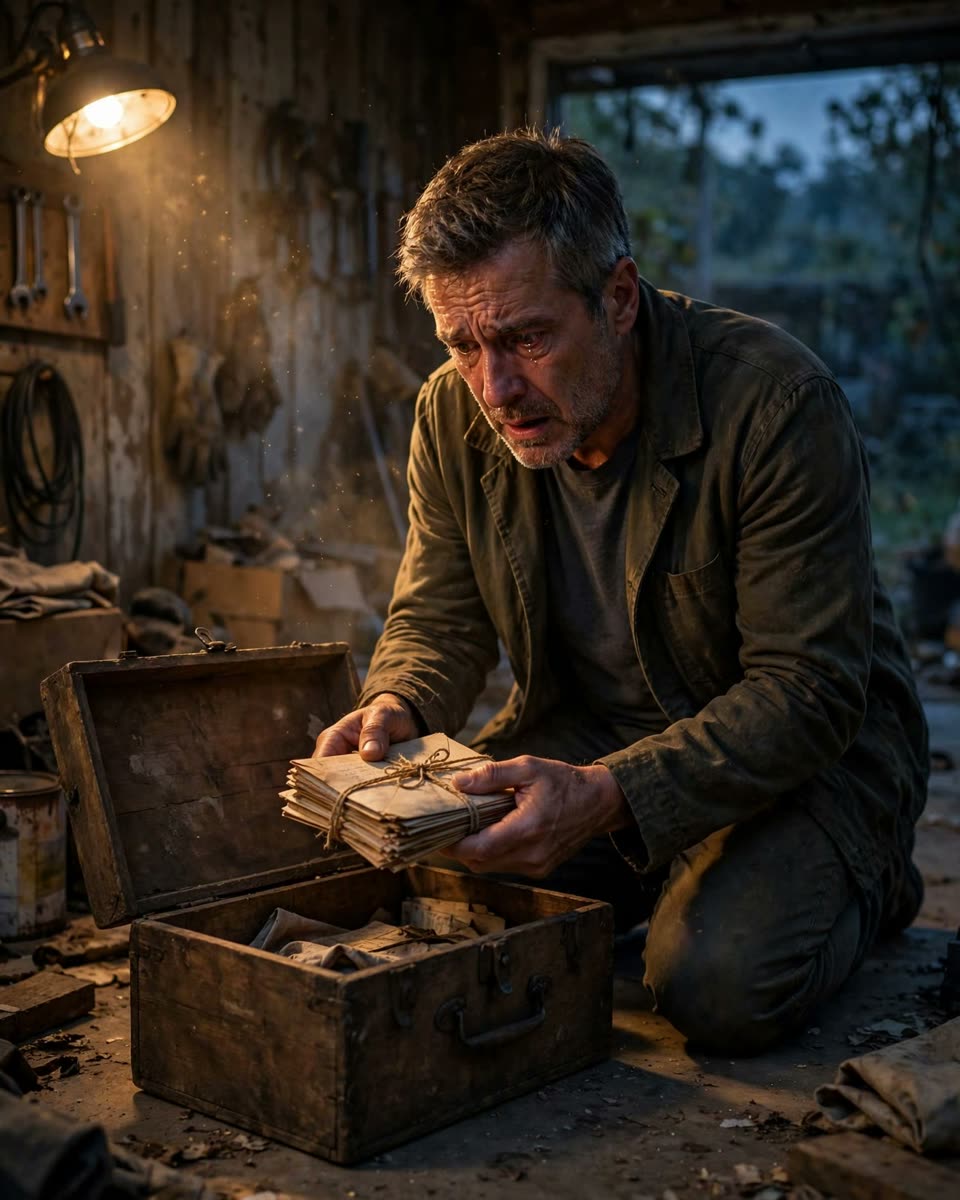
My father labeled his tools. Not with his name. With ours.
I found out three weeks after the funeral. My sister Maya called on a Tuesday and said, "We have to do the garage this weekend, Danny, or I'm going to lose my nerve." So I drove the two hours to Dad's house with a box of trash bags and a thermos of coffee, and neither of us threw away a single thing.
The house was too quiet. Dad's recliner still had the dent of him in it. His coffee mug was still in the dish rack — Maya had washed it the day after the funeral and put it back like he might come home and want it.
We started in the garage because the garage was Dad. It smelled like him — sawdust and coffee and that lemon soap he used, the kind that came in a yellow bar and lasted approximately forever.
Every wall was pegboard. Every tool had its outline drawn in black marker. A place for everything — that was Ray's religion.
But it was the little strips of masking tape that stopped me cold.
On the claw hammer: "DANIEL'S TREEHOUSE — 1998."
I remembered that summer. I was nine. Dad hit his thumb with that hammer so hard he saw stars, and then he looked at my scared face and said, "That's how you know it's a real treehouse — it costs blood." He wrapped his thumb in a paper towel and kept working.
On the wrench: "MAYA'S BIKE — 2004."
Maya went pale when she read it. "I crashed into the Hendersons' mailbox," she whispered. "Dad straightened the handlebars and told them it was a windstorm."
On the level: "PORCH RAIL — THE STORM, 2016."
On the snow shovel: "MRS. ABERNATHY'S DRIVEWAY — EVERY WINTER." He'd never told us about that one.
Dozens of them. Every tool in that garage was labeled with a memory, not a name. A whole life, written in masking tape.
"Did you know about this?" I asked Maya.
She shook her head. She was holding his tape measure, turning it over in her hands like it might explain something.
We spent the afternoon reading them out loud, and we laughed until we cried, which is the only way our family has ever done either.
Then Maya tried the bottom drawer of the workbench.
Locked.
In forty years, I'd never seen that drawer locked. It had always held sandpaper and spare screws and the general junk of the garage. Dad didn't lock things. Dad hid his spare house key in the freezer and told everyone at Thanksgiving.
"Maybe the key's on his ring," Maya said.
It wasn't. We checked twice.
We checked the coffee can of old keys in the laundry room. The tackle box. Under the workbench mat. The freezer, for old times' sake. Nothing fit.
I was on my knees with my phone flashlight, looking for a screw I'd dropped, when I saw it.
Taped flat underneath the workbench, where you'd never see it unless you were exactly where I was.
An envelope. "FOR DANIEL," in Dad's handwriting. "OPEN LAST."
My hands were shaking so bad Maya had to peel the tape.
Inside: a single brass key. And a note.
"The drawer was never about tools. — Dad"
Maya looked at me. I looked at the drawer.
Here's the thing I haven't told you yet. The last thing I ever said to my father was about the lake house. He wanted to sell it — said it was too much upkeep, said we never used it. I told him he was erasing Mom. Then I said the thing I can never take back: "You're just like her when you're stubborn."
Mom had been gone six years. He went quiet. We didn't speak for two years. Then the phone rang at 2 a.m., and a nurse said "heart attack," and I never got to say I was sorry.
I put the key in the drawer. It turned like it had been waiting twenty years.
The drawer slid open, smooth and silent.
Not sandpaper. Not screws.
A stack of envelopes, tied with twine. One for every year since I was born. And on top, in Dad's handwriting:
"DANIEL — FOR THE DAY YOU STOP BEING ANGRY AT ME."
I sat on the garage floor and opened it.
"Danny," it began. Nobody called me Danny but him. Not Maya, not my wife. Just Dad.
"If you're reading this, the garage is empty and I'm gone, and you're still mad about the lake house. So let me say it plain: I was wrong. You were right. I was too proud to say it on the phone, so I'm saying it in a drawer. Typical Ray."
Maya was crying quietly beside me, her hand on my shoulder.
"The tools," he wrote, "were never about fixing things. They were about showing up. Every label is a day I got to be your father. The treehouse — you were so scared of heights, remember? You cried on the third rung, and I sat up there with you for an hour until you weren't. The bike — Maya's crash, the mailbox, the windstorm lie. The porch rail — your mother stood in the rain holding the flashlight while I worked, and she never complained once."
"I kept them because I was afraid I'd forget. Then I realized — I labeled them so YOU wouldn't forget. Not the projects. The days. The days are the whole thing, Danny."
There were forty-four envelopes in that stack. One for each year of my life. Some had Maya's name on them too — she held them to her chest without opening them. "Later," she whispered. "When I'm ready."
I only opened the first.
The last line of Dad's letter said: "The rest are for birthdays I'm going to miss. Open one a year. And Danny — build something with your kids. Label it. Don't skip the label. The label is the point."
We didn't sell the house that month. Or the next. We kept the garage exactly as it was — every outline, every strip of tape.
Last Sunday, my son Jacob asked to borrow a hammer. He's eight. I handed him the claw hammer — the treehouse one — and showed him how to hold it, the way Dad showed me. Then I took a strip of masking tape and wrote: "JACOB'S BIRDHOUSE — 2026."
My hands were shaking. But in a good way, this time.
Maya texted me a photo yesterday. She's building a bookshelf with her daughter. There's a strip of tape on her drill. It says: "LILY'S BOOKSHELF — 2026."
The labels continue.
This story is a work of fiction, written to touch hearts and bring families closer.
← Back to all stories