The Blue Bicycle 🚲
A Clipp Kaili original story
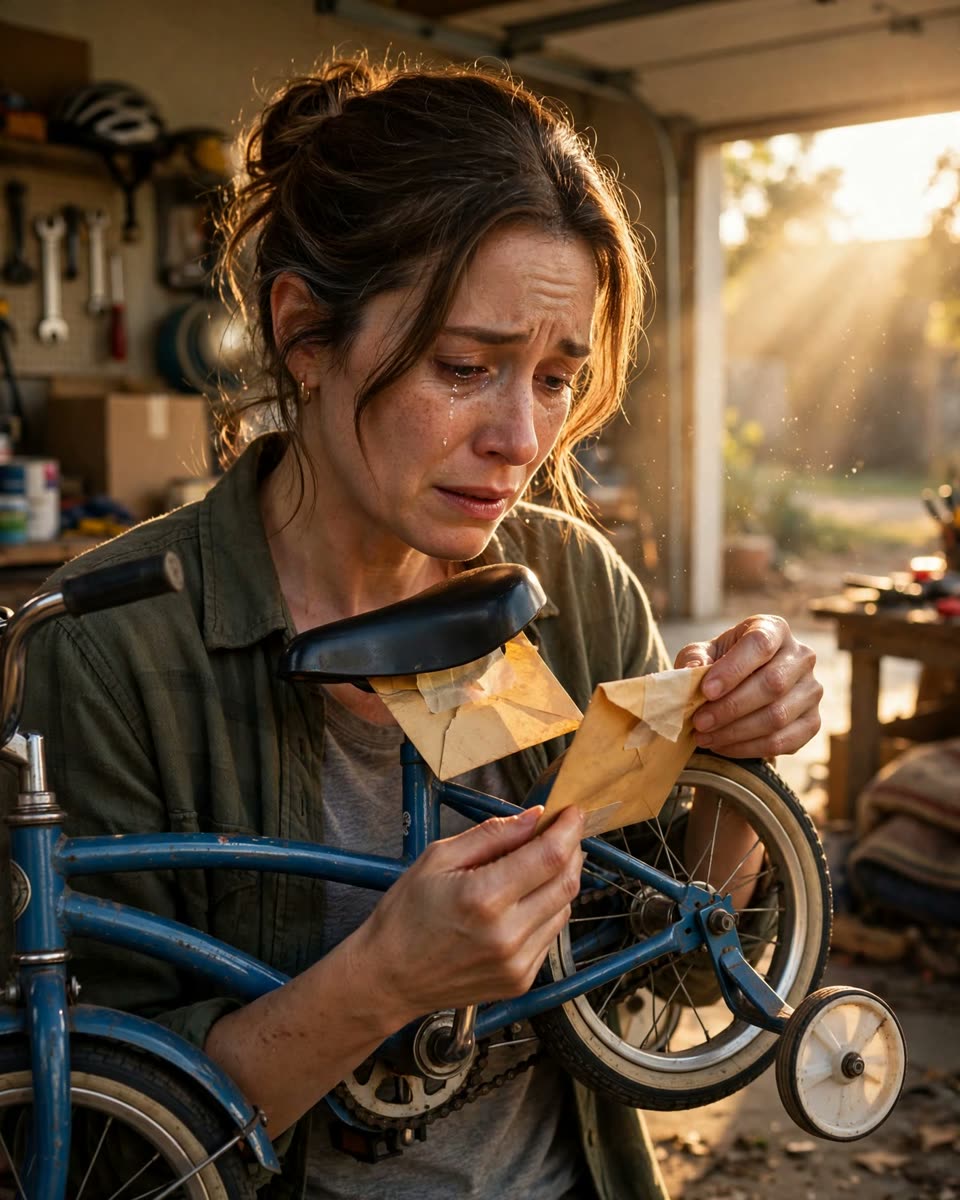
The bike still had its training wheels. My daughter is thirty-four.
I found it in my mother's garage last Saturday, standing in the corner under a sheet like it was a piece of furniture. When I pulled the sheet off, I actually gasped.
It was my blue bicycle. The one my father gave me for my seventh birthday. The paint was still bright. The tires still held air. The little bell still worked — I pressed it, and the sound went straight through thirty years and hit me in the chest.
My father died when I was nine. A heart attack, no warning, gone between breakfast and lunch. I remember the ambulance lights through the kitchen window. I remember my mother screaming my name like the syllables were breaking. I remember thinking, very clearly: this is the worst day, and I will never be okay again.
After that, Mom couldn't look at his things. She packed the garage like a museum she never visited — his workbench, his fishing rods, my little blue bike — and she shut the door on all of it.
"Mom," I said last Saturday, standing in that garage with dust in the sunlight, "why did you keep it like this?"
She was sitting in her wheelchair by the door. She'd moved to assisted living in the spring, and we'd come to clean out the house — the real clean-out, the one we'd been avoiding for years. She watched me with those eyes that miss nothing.
"Your father kept it like that," she said. "Not me."
That stopped me. "What do you mean?"
"Every spring," she said, "he'd go out there. Pump the tires. Oil the chain. Wipe it down. The neighbors thought he'd lost his mind, talking to a little girl's bicycle. He said you'd ride it again when you were ready."
I wasn't ready. That was the thing. After he died, I never got back on a bike. The training wheels stayed on because I never got good enough to take them off — because the summer I was supposed to learn, the summer I turned eight, he was gone. Fear just... moved in, and I let it stay. For thirty years.
The summer after he died, Mom tried once. She took the bike down to the driveway, held the seat the way he'd held it, and said, "Come on, Sarah, let's try." I wobbled three feet and burst into tears — not because of the bike, but because her hands weren't his hands. She never tried again. Neither did I.
"But it stayed perfect," I said, looking at the gleaming blue paint. "Thirty years. Who—"
"I did," Mom said quietly. "Every spring. Pump the tires, oil the chain, wipe it down — exactly the way he taught me. Somebody had to be ready for the day you were."
The garage was a time capsule. His workbench exactly as he left it — the coffee mug with the dried ring inside, the little radio stuck between stations. On the doorframe, a growth chart in pencil: my height at five, six, seven, eight. The last mark at nine, dated the month before he died. I touched it, and my fingers came away dusty.
I ran my hand along the handlebar, and that's when I felt it. Taped under the seat. An envelope, yellow with age, soft as cloth.
Inside, in my father's big careful handwriting — the handwriting from my birthday cards, the ones Mom saved in a shoebox: "FOR SARAH — FOR THE DAY SHE RIDES WITHOUT FEAR."
My throat closed up. I was seven years old again, wobbling down the driveway, his big hand steady on the back of my seat, his voice low and sure: "I got you, baby. I got you."
I turned the envelope over. Something small and hard slid out into my palm.
A child's helmet. Blue, to match the bike. Brand new, thirty years old, never worn.
And written inside the helmet, in permanent marker, in my father's handwriting — a name.
It wasn't mine.
I sat down hard on the garage floor, the concrete cold through my jeans.
"Mom," I whispered, holding it up. "Whose name is this?"
She wheeled closer and looked. And she smiled — the first real smile I'd seen on her face in months, the kind that reached her eyes.
"His," she said. "He bought himself one. You told him you were scared to ride alone — you said the other kids would laugh at the training wheels — so he said, fine, then I'll look silly too. He was going to ride next to you, training wheels and all, until you weren't scared anymore. He'd already picked the route. Down to the park and back. He was so excited, Sarah. Like a kid himself."
"But he never—"
"He never got the chance, baby." Her voice didn't break. Thirty years of practice. "The heart attack was in March. Your birthday was in June. He'd already wrapped the helmet."
I held that little blue helmet — my big, strong father's helmet, sized for a grown man who was willing to look ridiculous for his little girl — and I cried the way you cry when you're thirty-eight and suddenly seven, sitting on a garage floor with your whole childhood in your lap.
Then my phone buzzed. A text from my husband: "Emma's asking for you. She wants to learn to ride her bike but she's scared. The training wheels are still on."
Emma. My six-year-old. Scared of her bike. Scared of looking silly.
I looked at the blue bicycle. At the helmet with my father's name in it. At my mother, watching me with those eyes that miss nothing.
"Mom," I said, standing up, "can I take the bike?"
She nodded. "It's been waiting long enough."
That afternoon, I loaded it into the car. At home, I pumped up Emma's tires. I put on my father's blue helmet — it was a little loose, and I tightened the strap, and somehow it felt exactly right. And I ran beside her down our driveway, my hand steady on the back of her seat, and I heard myself say the words before I knew I was saying them:
"I got you, baby. I got you."
She wobbled. She laughed — that bright, startled laugh. She didn't fall.
And from the porch, my mother — who'd insisted on coming to watch — pressed the little bell on the blue bicycle.
It still worked. Of course it did. He'd oiled it every spring.
This story is a work of fiction, written to touch hearts and bring families closer.
← Back to all stories