The Last Stop 🚌
A Clipp Kaili original story
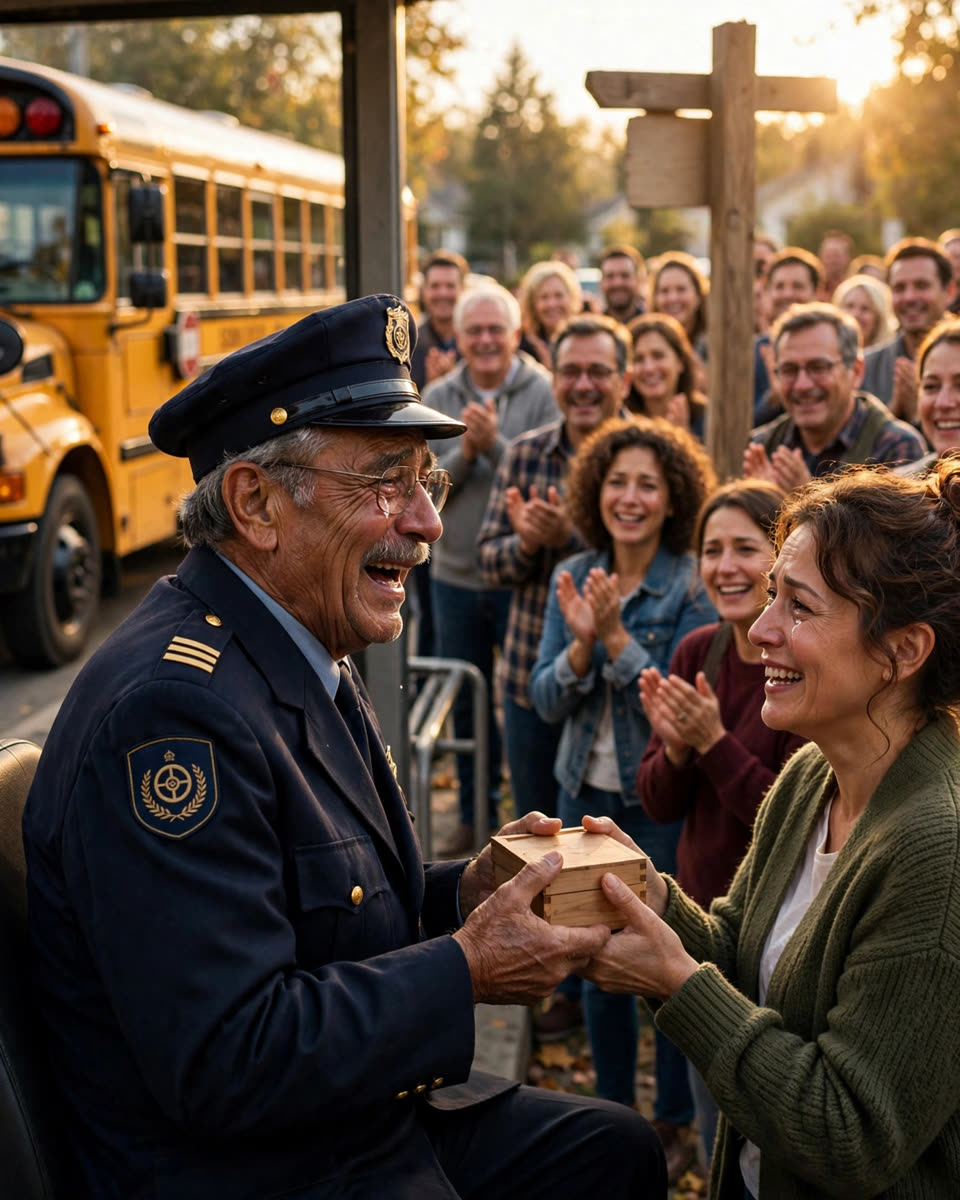
Two hundred grown adults skipped work on a Tuesday to stand at a school bus stop.
I was one of them.
We stood there in suits and scrubs and steel-toed boots, coffee going cold in our hands, watching the yellow bus come around the corner one last time.
The driver saw us and nearly drove off the road.
Harold Callahan. Sixty-eight years old. Thirty years on Route 9. And he had no idea.
The bus hissed to a stop. The door folded open. He stepped out with his cap in his hands and just stared at us — two hundred adults lined up along his curb like we were waiting for a parade.
"What in the world..." he said.
Nobody had told him. That was the whole point.
It started eleven days earlier with a group text. Denise, a mom from the route, typed six words:
"He retires Tuesday. Let's be there."
By Monday night, two hundred people had confirmed. Doctors. Lawyers. Mechanics. A state senator. A woman who'd flown in from Chicago.
All of us once small enough to need a booster seat. All of us once his kids, twice a day, nine months a year.
I remembered my own mornings — the bus sighing to a stop in the dark, Mr. Callahan calling every kid by name like we mattered. "Morning, sunshine," he'd say, even in February, even when the heater rattled. Nobody else talked to us like that at 6:40 in the morning.
Someone started clapping. Then everyone was clapping, and the sound rolled down that quiet street like thunder.
Mr. Callahan cried. Right there on the curb. Sixty-eight years old, thirty years a driver, crying like a little kid.
"Y'all are gonna make me late," he said, wiping his face with his sleeve. "I got a route to finish."
So we let him finish it. Two hundred of us stood in respectful silence and watched that empty yellow bus pull away — the last run of Route 9, ever.
But here's the thing nobody put in the group text. Here's the real reason we came.
It wasn't just about thirty years of driving.
It was about what he did on those drives. The things most of us never knew — until the stories started pouring out Monday night in that group chat.
Like the winter of '98, when he waited forty minutes in a blizzard for a six-year-old who missed the bus, because her mother worked two jobs and couldn't come.
Like the spring the river flooded, when he drove the long way around — two extra hours on his own time — so no kid on his route had to walk through it.
Like the quiet girl with the bruises on her arms, the one he watched, the one he reported, the one whose life he probably saved just by paying attention when nobody else did.
Two hundred people. Two hundred stories. Thirty years of mornings nobody thought he noticed.
Denise read some of them aloud Monday night while we planned — her voice cracking over the phone. The boy who left his retainer on the bus twelve times. The twins he sang happy birthday to over the intercom. The kid who threw up in third grade, and Mr. Callahan cleaned it himself so nobody would tease him. We laughed. We cried. We kept reading until midnight.
He noticed everything.
The bus came back around the corner twenty minutes later, empty, its lights off. Mr. Callahan climbed down slowly, like a man who didn't want the day to end.
The crowd parted.
And a woman stepped forward carrying a small wooden box, her hands trembling.
She stopped in front of him. She looked up at the man who'd driven her to school a lifetime ago.
The whole street went silent. Even the birds seemed to stop.
"Mr. Callahan," she said, "you won't remember me. But I need you to open this."
He opened the box with shaking hands.
Inside, resting on folded cloth: a tiny yellow school bus, carved from wood by somebody's grandfather. And beneath it, a note in careful handwriting.
"Route 9. Winter, 1998. You waited forty minutes in a blizzard for a scared six-year-old girl who missed her bus. Her mother worked two jobs and couldn't come. You told her, 'I don't leave kids behind.' I'm a doctor now. I have never forgotten. — Maya"
Mr. Callahan stared at that note for a long time.
"I remember," he whispered. "Little Maya. Pink hat. Cried the whole way."
Maya — Dr. Maya Chen now — hugged him so hard his cap fell off into the street.
And then it happened. One by one, people stepped out of the crowd.
A mechanic, grease still under his nails: "You got me home safe every day my dad was deployed."
A teacher with tears streaming: "You noticed when I stopped eating lunch, and you told my mom."
A firefighter: "You taught me my times tables at red lights."
Story after story after story, until the sun was fully up and the whole street was crying.
Denise stood off to the side, crying the hardest — eleven days of secret planning pouring out of her all at once.
Then the mayor stepped forward — because the town council had voted quietly the month before, and Denise had known for weeks.
He held up a wooden sign, freshly painted, and two of the dads mounted it on the bus stop pole right then and there.
"Callahan's Corner."
Mr. Callahan stood under that sign and cried all over again, and two hundred grown adults cried right along with him.
Thirty years of 6 AM mornings. Thirty years of "sit down, honey" and "you're safe now" and headlights cutting through the dark to find one small kid waiting.
He thought nobody noticed.
We noticed every single one.
This story is a work of fiction, written to touch hearts and bring families closer.
← Back to all stories