The Compass 🧭
A Clipp Kaili original story
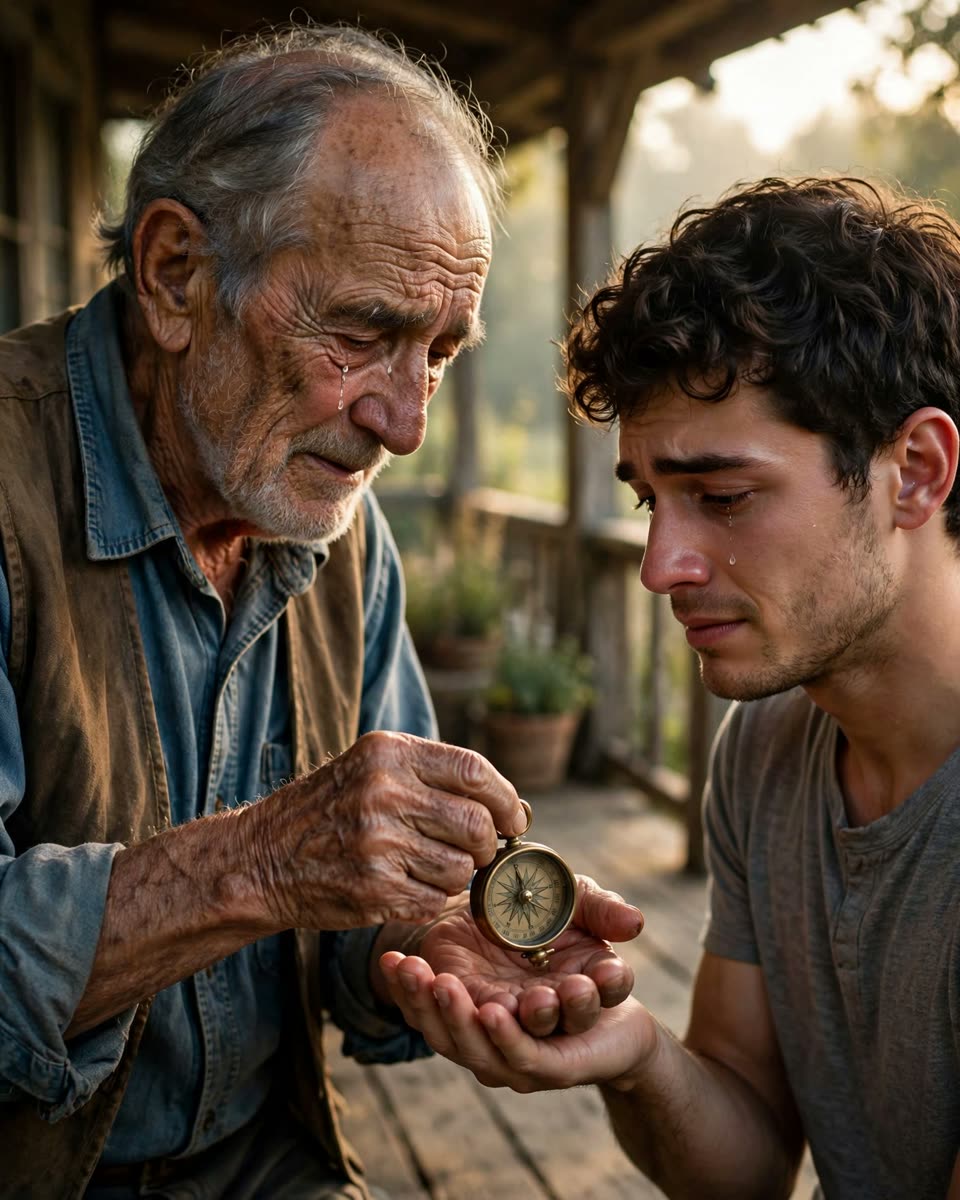
The compass didn't point north. It hadn't in sixty years.
My grandfather Henry gave it to me the night before I left for college — three states away, the farthest I'd ever been from home. We sat on his porch in the dark, the crickets going crazy, and he pressed the old brass compass into my palm and closed my fingers around it. His hands were shaking. They'd been shaking for a year, and we all pretended not to notice.
"It'll point you home," he said.
I turned it over. The glass was scratched. The case was dented. The needle was stuck fast, pointing... I checked my phone. Not north. Not even close. It pointed stubbornly east-southeast, like it had somewhere better to be.
"Grandpa," I said gently, "I think it's broken."
He smiled — that slow Henry smile that took its time. "I know."
That was Henry. Eighty-seven years old, a man of about twelve words a day, and he gives me a broken compass and calls it a gift.
"Your great-grandfather carried it in the war," he said, nodding at the brass. "Then I carried it in mine. Now you carry it in yours."
"My war is freshman orientation, Grandpa."
"Same thing," he said. "Just with worse food."
I laughed, and then I hugged him hard, the way you hug someone when you're trying to memorize them. He smelled like pipe smoke and Old Spice, same as always. "I'll call every Sunday," I said.
"You'd better," he said. "Your grandmother would haunt you."
The first week of college, I was lost. Not metaphorically — literally. My dorm, my classes, the dining hall, the library — all of it a maze of brick and panic. On the third day, I got turned around between the science building and the parking lot and ended up sitting on a bench, eighteen years old, three states from home, trying not to cry.
I took out the compass. Turned it over in my hands. And that's when I noticed something I'd missed on the porch — tiny engraving on the back, worn almost smooth by decades of thumbs.
Coordinates.
I typed them into my phone with shaking fingers. I expected our hometown. Our street. Our house. That's what "it'll point you home" meant — obviously.
They weren't.
They were somewhere I'd never heard of. A place in the mountains, two hundred miles from anywhere we'd ever lived. I zoomed in on the satellite view: nothing but ridges and trees and a whole lot of nowhere.
I called my grandfather that night. My mother picked up — which was strange, because it was only 8 p.m., and Grandpa always answered his own phone.
"Jake," Mom said quietly. "Grandpa's in the hospital. Pneumonia. We didn't want to worry you during your first week."
The bench, the maze, the homesickness — all of it vanished. "Is he okay?"
"He's asking for you," she said. "Hold on."
A rustling. Then his voice, thin as paper: "There's my boy."
"Grandpa," I said, and my voice broke clean in half. "The coordinates on the compass. Where do they go?"
He was quiet for a long time. I could hear the hospital machines beeping behind him.
Then he said: "Read me the numbers again, Jake. Slowly."
I did.
And he started to cry. In eighty-seven years — through a war, through burying his wife, through all of it — I'd never heard my grandfather cry.
"Oh," he whispered. "You found it."
"Sixty years ago," he said, his voice thin through the phone, "my unit got separated in the mountains. It was the third day, and we were out of food, and the compass broke on a rock — that's when the needle stuck. Just... froze. I navigated by the stars for three days, Jake. Three days. On the fourth morning, I crested a ridge, half dead, and I watched the sun come up over a valley — gold and pink, the most beautiful thing I'd ever seen — and I knew. I just knew. I was going to live."
I was crying now, sitting on that bench in the dark, eighteen and unravelled.
"So the coordinates are where you—"
"Where I promised God," he said, "that if I made it home, I'd bring your grandmother there someday. To stand on that ridge. To see the sunrise that saved me. I had it engraved so I'd never forget."
"Did you?" I whispered. "Did you ever take her?"
A long pause. The machines beeped.
"We never made it, Jake. Life got busy — the store, the kids, the mortgage. Then she got sick. Then... well. The years just went. I carried that compass every day for sixty years, and I never made it back to that ridge."
I didn't sleep that night. I lay in my dorm bunk staring at the ceiling, holding sixty years of somebody else's unfinished promise.
The next Friday, I borrowed my roommate's car and drove six hours into the mountains. I hiked the last two miles with the compass in my pocket and my grandfather's voice in my head. At dawn, I stood on that ridge — the exact ridge, I was sure of it — and I watched the sun come up over the valley. Gold and pink. The sunrise that saved him.
I took a photo. I picked up a small, smooth stone and put it in my pocket next to the compass.
Grandpa made it out of the hospital — stubborn old goat. When I walked into his room and put that stone in his shaking hand and showed him the photo, he held it to his chest and cried for the second time in eighty-seven years.
"You pointed me home, Grandpa," I told him, crying too. "So I pointed you back."
He keeps the stone on his nightstand now, next to his pills and his glasses. The compass is back in my pocket, where it belongs.
It still doesn't point north. It never will.
It points to the place that matters.
This story is a work of fiction, written to touch hearts and bring families closer.
← Back to all stories