Pancake Sundays 🥞
A Clipp Kaili original story
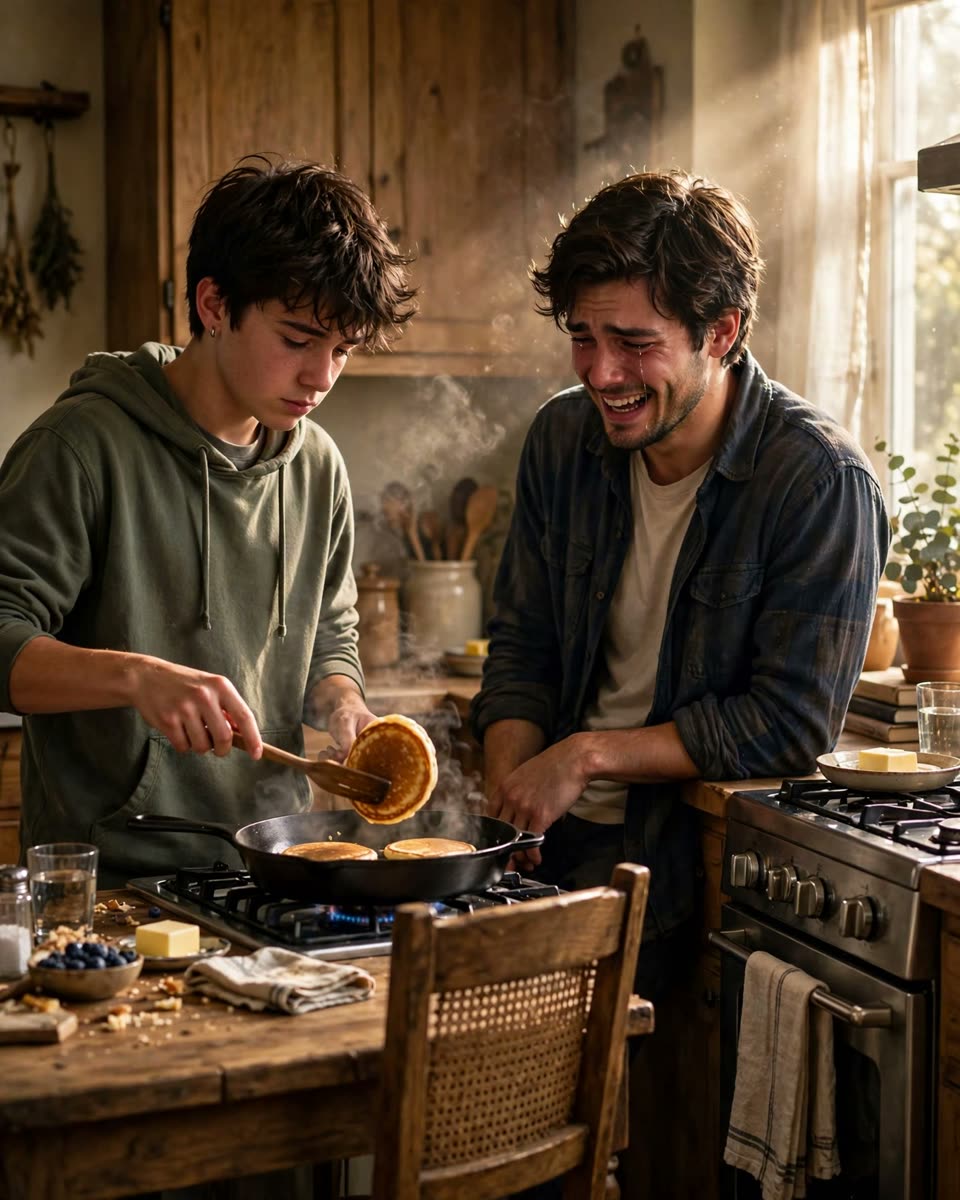
The smoke alarm went off at 7 a.m. My brother was making Dad's pancakes.
I'm Tyler, sixteen. My brother Chris is nineteen. Our dad died eight months ago — a stroke, out of nowhere, forty-nine years old. One minute he was mowing the lawn, waving at me. The next minute the ambulance was in our driveway, and Mom was screaming, and nothing has been normal since.
Since then, Mom works double shifts at the hospital. She leaves before we're up and gets home after we're asleep, and she leaves notes on the fridge in her tired handwriting: "Heat the lasagna. Love you. — Mom." So Sundays are ours. Mine and Chris's. And Sundays mean pancakes. They've meant pancakes since I was five.
Dad's pancakes weren't just pancakes. They were an event. He'd put on his apron — the one that said "GRILL SERGEANT" in big letters, the one Mom got him as a joke that he wore completely seriously — and he'd flip them one-handed while telling the worst jokes you've ever heard. "What do you call a fake noodle? An impasta!" Chris and I would groan loud enough to shake the windows. Mom would pretend not to laugh, and then she'd laugh.
After Dad died, the first Sunday was the worst. We all just sat there at 7 a.m., staring at the cold stove. Then Chris — eighteen years old, never cooked anything but ramen — stood up and said, "I'll do Sundays."
The first batch was raw in the middle. The second was hockey pucks. But we ate them anyway, the three of us, because it wasn't about the pancakes. It was about 7 a.m. It was about being in the same room. It was about not letting the silence win.
This Sunday was different. I woke up to the smoke alarm screaming and the smell of burning, and I ran downstairs in my socks to find Chris standing in a cloud of smoke, holding a blackened pancake with the tongs, staring at Dad's empty chair at the table.
The chair nobody sits in. The chair we all see.
"I can't do it," Chris said quietly. He didn't look at me. "Eight months, Ty. I can't make them like him. They're never going to be like his."
That's when I noticed the recipe box. Dad's old wooden recipe box, the one that lived on top of the fridge for as long as I could remember, covered in twenty years of kitchen dust. Chris had pulled out the pancake card.
I picked it up. Dad's handwriting — big, looping, cheerful — the ingredients, the steps. But in the margins, in smaller writing, squeezed into every corner, were notes I'd never seen:
"Flip when the bubbles pop — like I taught Chris, age 7."
"Extra vanilla for Tyler. He'll pretend he doesn't notice. He notices."
"For Mom — the burnt one. She likes the crispy edges. Don't tell her I told you."
My eyes were burning, and it wasn't the smoke.
Then Chris said, very quietly, "There's something on the back."
I turned the card over.
Taped to the back was a phone. Dad's old phone — the cracked-screen one he'd kept as a backup, the one we'd all forgotten about after the funeral.
And on the screen, one video file. Dated two years ago. Titled: "FOR PANCAKE EMERGENCIES."
Chris's hands were shaking as he pressed play.
Dad's face filled the screen, grinning in the GRILL SERGEANT apron, flour on his cheek. "If you're watching this," he said, "I'm either gone or I finally burned the house down. Chris — step away from the stove."
We laughed so hard we cried. Or cried so hard we laughed. Same thing, in our house.
Then Dad leaned closer to the camera, and his grin faded, and he looked straight at us — straight through two years — and said:
"But seriously. There's something I need to tell you boys."
"The pancakes were never about pancakes," Dad said.
He glanced off-camera, like he was making sure Mom wasn't listening, and lowered his voice.
"When you were little, Tyler — you were five — you asked me why we do this every Sunday. I told you it was tradition. But the truth is, your mother and I almost split up that year. Things were bad. Money, stress, the house, all of it. We were barely speaking."
Chris and I looked at each other. We'd never known. Not a hint. Not ever.
"One Sunday morning, I was going to tell her," Dad said. "I'd rehearsed the whole speech. Instead, I got up early and I made pancakes. I thought — one more Sunday. Just give me one more Sunday where we're us."
He smiled, sad and warm at the same time.
"And then another. And another. Twenty years of one-more-Sundays, boys. That's what the pancakes are. Showing up. Even when it's hard. Especially when it's hard. The marriage didn't survive because of grand gestures. It survived because of batter and a hot griddle and me burning the first batch every single time."
Chris was crying openly now, the tongs forgotten. I was holding the recipe card so tight it bent in the middle.
"So if I'm gone," Dad said, looking straight into the camera, "and you're watching this — keep the Sundays. Burn the pancakes. Set off the alarm. Your mom will yell, you'll laugh, and it'll be perfect. Because you'll be together. That's the whole recipe, boys. Together. Everything else is just details."
The video ended. The kitchen was quiet except for the smoke alarm's dying beeps and the two of us breathing.
Chris looked at me. I looked at him. Then we both looked at the smoking pan on the stove.
"One more batch?" he said, wiping his face with his sleeve.
"One more batch," I said.
They were terrible. Lopsided, half-burnt, completely perfect. We ate every bite, sitting in our usual spots, with Dad's chair empty and somehow full at the same time.
Mom came home at noon to a kitchen that smelled like smoke and two boys arguing about who flipped better. She stood in the doorway in her scrubs, exhausted to the bone, and she cried and laughed at the same time — and then she sat down in her spot, and Chris put a plate in front of her. The burnt one. Crispy edges.
She took one bite and looked at us. "He told you," she whispered.
We still do Sundays. The pancakes are getting better. Slowly. Chris can flip one-handed now — badly, but it's the thought that counts.
But Dad was right. It was never about the pancakes.
This story is a work of fiction, written to touch hearts and bring families closer.
← Back to all stories