The Umbrella ☂️
A Clipp Kaili original story
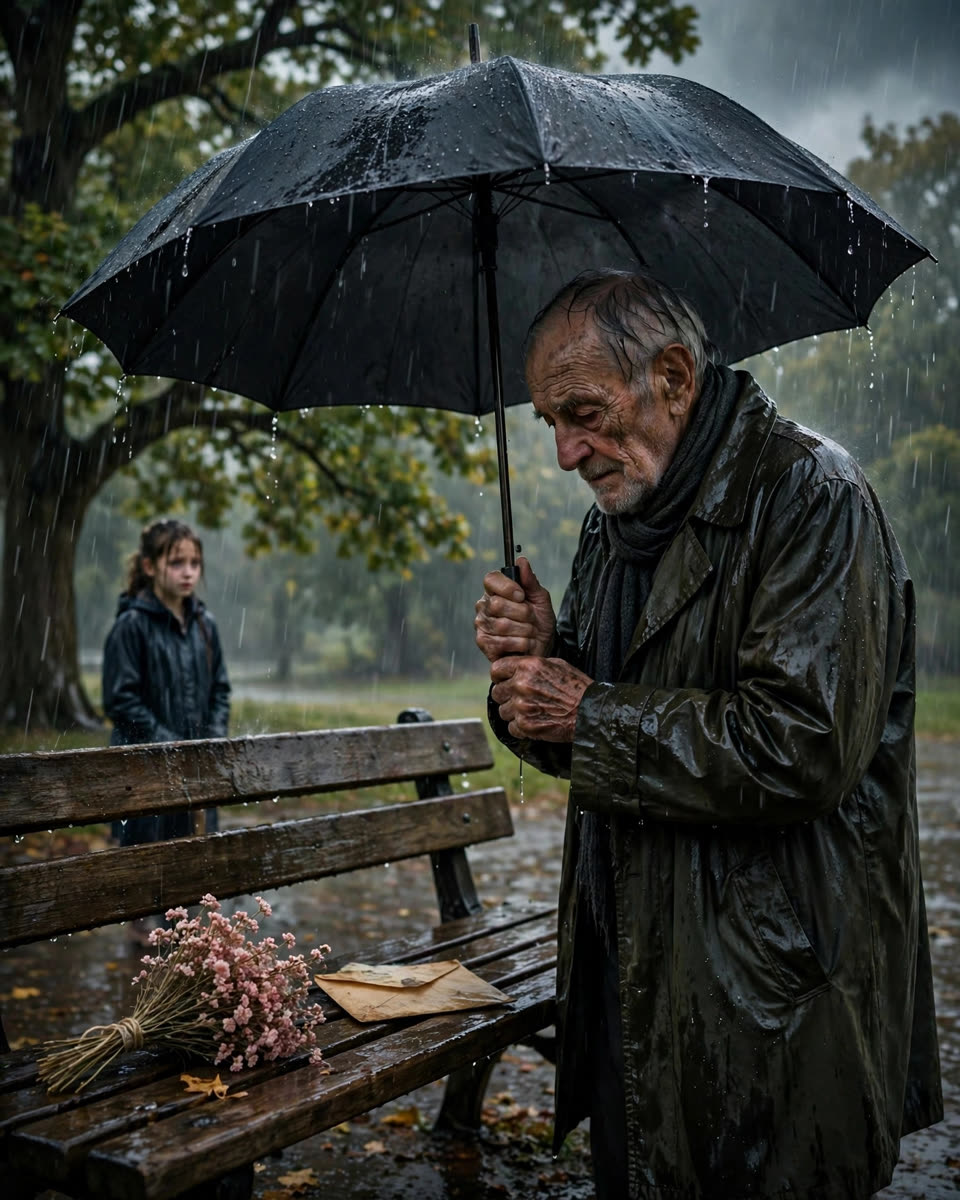
My eighty-one-year-old grandfather stood in pouring rain for three hours yesterday, holding an umbrella over an empty park bench.
Three hours.
Pouring rain.
An empty bench.
My mother called me in a panic. "He won't come inside. He's going to catch pneumonia. Please — go get him."
I drove to Miller Park with the windshield wipers slapping and my heart hammering.
The rain was coming down so hard the streets were rivers. All I could think about was his heart, his lungs, his eighty-one-year-old bones. Mom’s voice kept replaying on the phone: ‘He won’t come inside.’ Like he was a stray dog — and not the man who taught me to ride a bike.
And there he was, exactly where she said he'd be.
The old bench by the pond. The one with the peeling green paint.
As I got closer, I noticed something I had never seen in all my years of walking past it — initials carved into the armrest, worn nearly smooth by weather and time: J + E, 1962. My grandfather’s own hand had made those cuts sixty-two years ago.
Grandpa stood beside it in his good coat — the one he only wears to church — holding his big black umbrella high over the bench seat like it was the most important job in the world.
Rain ran off the umbrella in sheets. His shoes were soaked through. His shoulders were shaking.
But he didn't move.
A jogger ran past and stared. A woman walking her dog slowed down, then hurried on. Nobody stopped. In the rain, my grandfather looked like a statue someone had left out by mistake.
I pulled up, rolled down my window, and shouted, "Grandpa! Get in the car!"
He looked at me — calm, completely calm — and shook his head.
"She hates getting wet," he said.
I stared at him.
"Grandpa, there's nobody here."
"I know," he said, like I was the one not making sense.
I got out of the car and went to him, rain instantly soaking through my jacket.
That's when I saw what was on the bench.
A small bouquet of daisies. And a faded envelope, yellow with age, placed carefully in the exact center of the seat — right where the umbrella kept it dry.
"What's in the envelope?" I asked gently.
"Read it," he said. "Go on."
I picked it up with wet fingers. The paper was soft as cloth.
Inside, in shaky handwriting I recognized as his own, were five words:
"Same time next year. — E."
The ink was blurred at the edges, like it had been read in the rain many times before. It hit me then that this wasn’t the first anniversary he had carried it here. The paper was soft as cloth from years of unfolding.
My grandmother's name was Eleanor. She died ten years ago.
"Grandpa," I whispered, "what is this?"
He looked down at the bench — at the daisies, at the letter, at the dry wood under his umbrella — and his face softened into something I couldn't name.
"Sixty-two years ago," he said, "I proposed to your grandmother on this bench."
The rain drummed on the umbrella. He didn't seem to feel it at all.
"It was raining that day too," he went on. "She said yes, and then she laughed and said, 'Well, at least I know you'll keep me dry.'"
My throat closed up.
"Every year since," he said, "on this day, I come back. Rain or shine."
I looked at the envelope again. "Same time next year."
"She wrote that to me," he said quietly. "Our last anniversary. Before the hospital."
He adjusted the umbrella slightly, making sure not a single drop touched the bench.
"She's not here, son," he said, reading my thoughts. "I know that."
Then he smiled — the saddest, most beautiful smile I had ever seen.
"But the bench doesn't know that. And I'm not going to be the one to tell it."
I stood there in the rain with my grandfather, and suddenly I wasn't cold anymore.
"Tell me about the proposal," I said.
He laughed — a real laugh, rusty from disuse.
"I was twenty-three and terrified," he said. "I'd been carrying that ring for three weeks. Every time I tried to ask her, the words ran away."
It was October 1962. They'd walked to the park after church, and the sky opened up halfway there.
"Everyone else ran for cover," he said. "But Eleanor just sat down on that bench, rain and all, and said, 'Well? Are we walking or are we talking?'"
So he knelt — in a puddle, in his good shoes — and held up the ring.
"She said yes before I got the box open," he said, grinning at the memory. "Then she grabbed my umbrella and held it over both of us and said, 'See? Teamwork.'"
They were married fifty-two years.
When she got sick, near the end, he sat by her hospital bed every single day.
"She was barely awake that last week," he told me, rain dripping off his chin. "But on our anniversary, she opened her eyes, looked at me, and whispered, 'Same time next year.'"
He looked at the bench.
"I told her, 'Eleanor, you won't —' and she put her finger on my lips. 'Same time next year,' she said. 'Promise me.'"
"So I promised."
He'd kept that promise for ten years. Ten anniversaries. Rain or shine — mostly rain, he joked, because October never cooperated.
I took off my jacket and draped it over his shaking shoulders.
"Grandpa," I said, "can I come with you next year?"
He looked at me for a long moment.
"Bring an umbrella," he said.
So I did something that day I should have done years ago.
I called my mother. My sister. My cousins. Everyone.
I told them about the bench. About the letter. About the promise.
Next October, we won't let him stand in the rain alone.
There will be a row of umbrellas over that old green bench — one for every person who loved Eleanor, and one for every person who loves him.
Because love doesn't need a reason.
Just a dry bench, a kept promise, and a family who remembers.
This story is a work of fiction, written to touch hearts and bring families closer.
← Back to all stories