The Translator
A Clipp Kaili original story
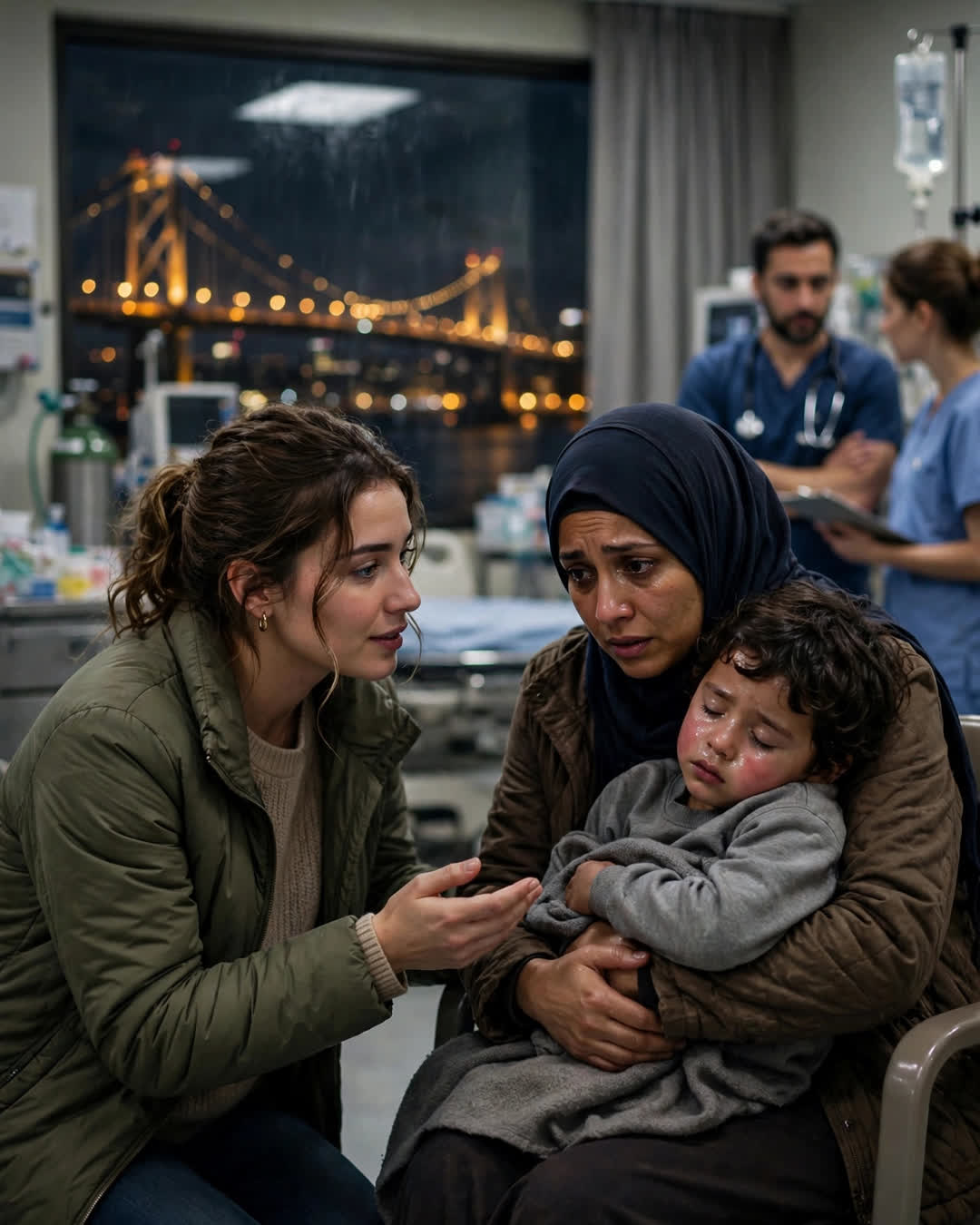
The emergency room nurse asked the family what was wrong, and the little boy answered by screaming for his grandmother in a language nobody on shift could speak.
It was 2 a.m. on a February night in Chicago, 2009. The Haddad family had been in the country eleven days. Their six-year-old son, Sami, had a fever of 105 and hadn't kept water down since noon. His mother held him and rocked and repeated the same Arabic words to every uniform that passed — words that meant my son, please, help — and watched every face fail to understand her. His father kept pointing at the boy, then at his own chest, then at the ceiling, a pantomime of pure terror.
A frightened family is loud. A frightened family nobody understands is something worse.
She was alone in the waiting room with a sprained wrist and a novel she would never finish.
Her name was Carla Mendoza, she was a twenty-nine-year-old school office clerk, and she had grown up in a house where her grandmother spoke only Spanish and the whole neighborhood translated for each other as naturally as breathing. Carla's Arabic was not perfect — she'd learned it from a college roommate and two years volunteering at a community center — but at 2 a.m., imperfect was a miracle.
"I can help," she told the nurse. "I think I can help."
She stayed.
She stayed through triage, translating "Has he had this fever before?" and "He is allergic to penicillin — write it down, allergic." She stayed through bloodwork, holding Sami's mother's hand and rendering a terrified woman's whole heart into clear English: that he was a good boy, that in Syria she was a schoolteacher and here she was nobody who could not even say fever.
By dawn, the fever broke. Sami slept, sweaty and peaceful. The doctors said another few hours without the allergy warning could have gone very differently. The family tried to press money on Carla. She refused everything except coffee from the vending machine, which Sami's father bought her like it was a ceremony.
"You were the bridge," he said in careful new English, bowing over her hand. "My son crossed on you."
Carla went home at sunrise and never saw them again.
Fifteen years later, Carla, now forty-four, sat in that same hospital — beside her own father, fresh out of heart surgery, disoriented, answering the nurses in the rapid Spanish of his childhood and understanding nothing back. Carla's Spanish had gone rusty with panic. She stood in that hallway drowning in the exact helplessness she had once watched on another family's faces.
Then a young doctor's interpreter stepped in — calm, quick, twenty-one years old, badge reading L. HADDAD — MEDICAL INTERPRETER.
"Take your time," Layla Haddad told the old man gently, in perfect Spanish, holding his hand. "I'm here. Nothing will happen that you don't understand."
Afterward, in the hallway, she turned to Carla with tears in her eyes. "My mother described you for fifteen years," she said. "The woman with the hurt wrist who gave us her whole night. I chose this work because of a story about a stranger in a waiting room. I never thought the hospital would let me repay it to her own family."
Carla's father recovered. He tells people his life was saved by two women in one hospital, fifteen years apart.
He is only half right.
It was one act of kindness, crossing the same bridge twice — once in each direction, in the dark, right on time.
This story is a work of fiction, written to touch hearts and bring families closer.
← Back to all stories