The Corner Store Tab
A Clipp Kaili original story
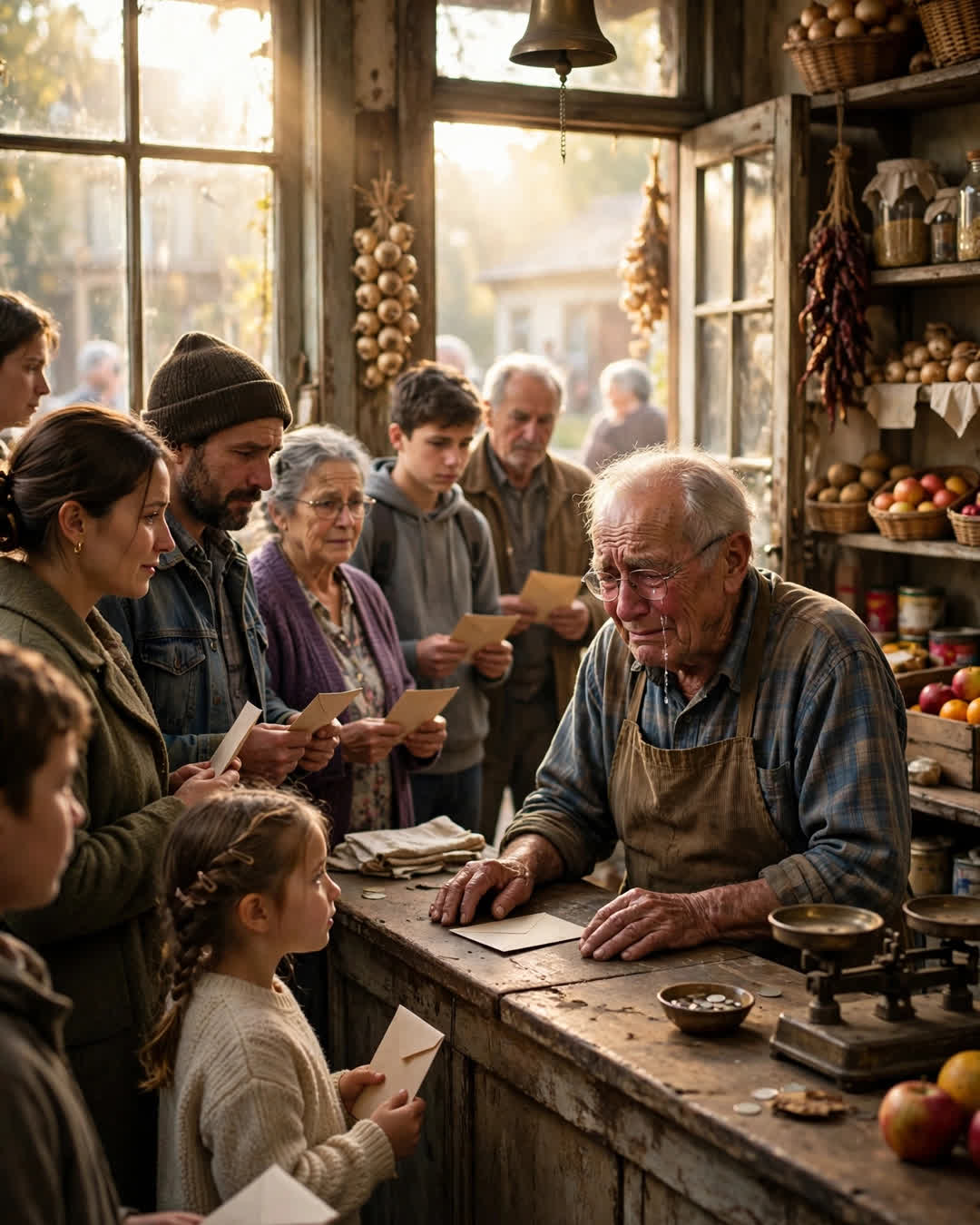
On the day Mr. Patel retired, forty-three people were standing in his store before he unlocked the door, and every one of them was holding an envelope.
He had run the corner store on Maple and Third for thirty-eight years. It was not much to look at — a bell over the door, coolers that hummed too loud, a counter worn smooth where three generations had set down milk and bread and bad news. But the people of our town knew what that store really was.
It was the place that fed you when the money ran out before the month did.
Mr. Patel kept a spiral notebook behind the register. No computer. No interest. No deadline circled in red. Just names and amounts in his careful handwriting, and one rule he explained to you quietly, so your kids would not hear: "You pay when you can. If you cannot, you pay somebody else someday. We write it here so we remember we are a town."
My family lived in that notebook for two full years after Dad hurt his back at the plant. Milk, eggs, soup when Mom was sick, a birthday cake mix my mother still talks about like it was gold. Every Friday, Dad would go in and pay what little he had, and Mr. Patel would nod and cross out a number and never once make him feel smaller for it.
We were not the only ones. Half the town had a page in that book at some point. A layoff. A funeral. A new baby and no overtime. The notebook stayed behind the register, and dignity stayed intact, because Mr. Patel understood something banks never have.
People are not late because they are lazy. Most of the time, they are late because life got there first.
When the big grocery chain opened by the highway, everyone said the corner store would die. It did not. People drove past cheaper milk to buy his, on purpose, for years. But at seventy-four, with his hands aching and his daughter asking him to rest, he finally agreed to retire. He sold the building. He told almost no one the last day.
Word travels in a town that owes you.
His daughter organized it in three days. Mrs. Alvarez from the bakery made the list. The high school printed flyers that said nothing except: "Saturday. 8 a.m. Bring what you owe, if you ever owed. Bring a thank-you, if you didn't."
I was thirty-one, standing in line with my father, both of us holding envelopes. Dad's hands shook when he gave his over. Inside was the last sixty dollars of a debt he had technically settled in 1998 — plus enough extra for, in his words, "the interest of being treated like a man."
One by one, people paid. Some paid old balances. Some paid for families they knew were still struggling. A woman none of us recognized paid three hundred dollars and said her late husband had eaten from that notebook through an entire winter in 1987 and made her promise, on his last good day, that if the store ever closed, she would come.
By ten o'clock, the counter was buried in envelopes.
Mr. Patel stood behind it the way he had for thirty-eight years, overwhelmed, wiping his eyes with the same handkerchief he used for everything. When the noise finally settled, he held up the old spiral notebook and said, "You see? Every page, paid. Not in money." He tapped his chest. "Here."
He donated every dollar that morning to the food pantry and had the notebook framed.
It hangs in the new library now, open to a blank page.
Underneath, a small plaque reads: "For the next hard year. There is always room for one more name."
This story is a work of fiction, written to touch hearts and bring families closer.
← Back to all stories