The Auction 🔨
A Clipp Kaili original story
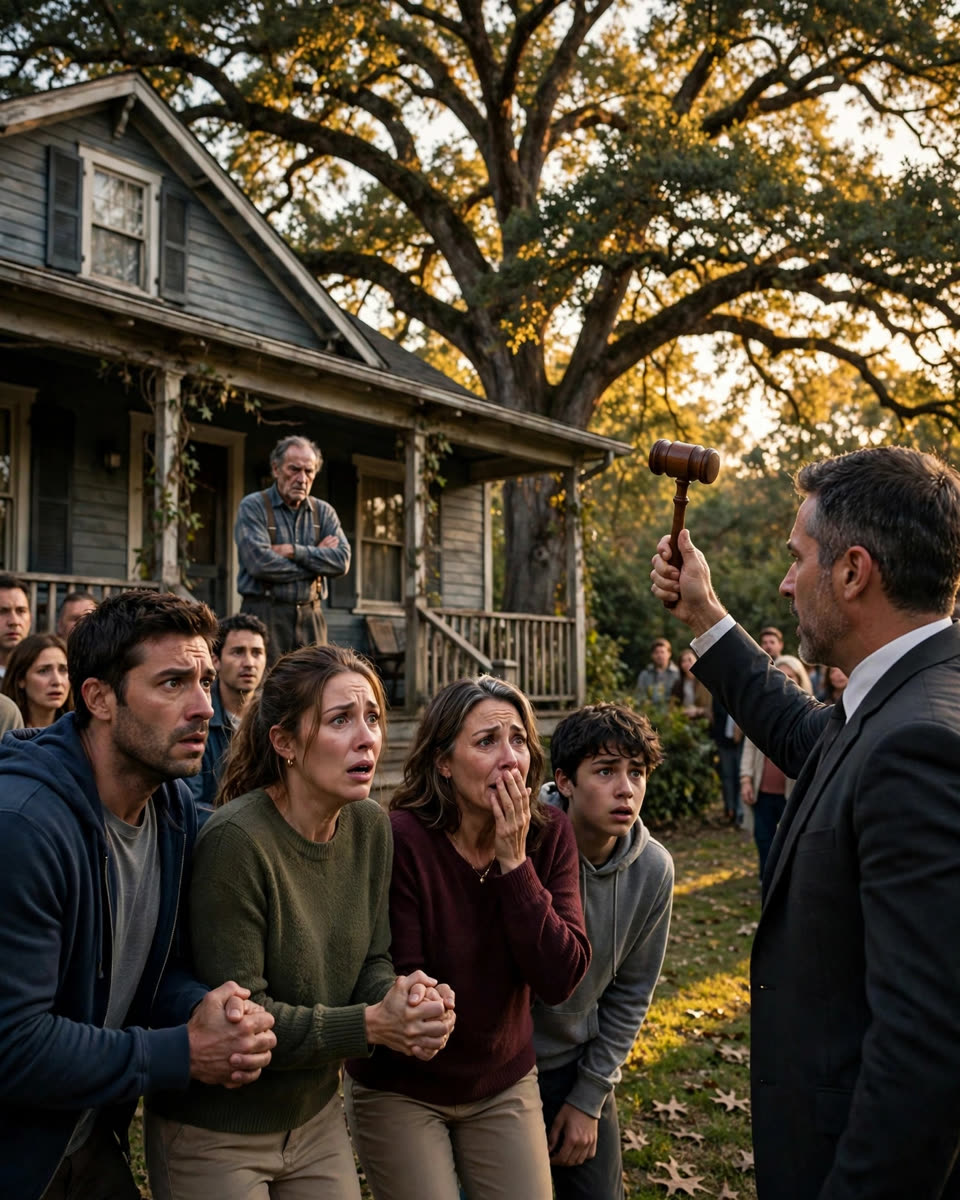
My father auctioned off our childhood home on a Tuesday morning — and he didn't tell any of us until the bidding started.
I stood on the front lawn in my work uniform, watching strangers walk through my mother's kitchen with numbered paddles in their hands.
Lot 47.
Starting at eighty thousand.
The red-and-white AUCTION TODAY sign had gone up on Monday night while we were all asleep. No warning. No family meeting. Just my father, standing on the porch with his arms crossed and his face like poured concrete.
"Dad, what are you doing?" my sister Lisa hissed, grabbing his sleeve.
"What's best," he said.
Two words. Like he was commenting on the weather.
The auctioneer was a loud man with a louder tie. He planted himself on our porch steps — the steps where I learned to tie my shoes — and started chanting numbers like our entire childhood was a clearance sale.
"Eighty thousand, do I hear eighty-five? Eighty-five! Ninety? Ninety thousand!"
Strangers nodded. Paddles rose. A man in a navy blazer measured the living room windows with his eyes, the way you look at something you're already planning to tear down.
I wanted to scream.
This was the house where Mom grew tomatoes the size of softballs. Where Dad taught me to ride a bike, running beside me all the way down Maple Street with his hand on the back of my seat. Where every birthday candle I ever wished on got blown out at that kitchen table.
And now it was Lot 47.
Neighbors gathered on the sidewalk, whispering. Mrs. Abernathy from next door pressed her hand to her mouth. Nobody understood. None of us did.
"Dad," I said quietly, stepping close. "Please. Talk to us."
He stared straight ahead. "Nothing to talk about."
Through the front window, I caught a glimpse of the living room — and my stomach dropped. The bookshelves were empty. Boxes stood stacked along the wall, taped and labeled in Dad's blocky handwriting. KITCHEN. BEDROOM. MOM'S THINGS. He hadn't decided this on Monday night. He'd been packing for weeks — right under our noses, and none of us had noticed.
But there was something in his face — under the concrete. His eyes were red. He hadn't slept. I could tell. I'd seen that look once before, the week Mom died.
Two bidders pulled ahead of the crowd. The developer in the navy blazer — the teardown kind, the kind who says "opportunity" the way other people say "good morning." And a young couple, maybe thirty, holding hands so tight their knuckles were white.
"One hundred thousand!" the developer called, smiling.
"One-oh-five," the young woman said softly.
"One-ten."
"One-fifteen."
Back and forth. The developer never stopped smiling, like it was a game he'd already won. Twice he stepped aside to take a phone call, laughing softly about "the teardown timeline" like our house was a joke he'd already heard the punchline to. The young couple huddled closer with every bid, the woman doing frantic math on her phone, the man's jaw tight, their hope leaking out of them in real time.
Lisa was crying now. "Dad, stop this. Please stop this."
He didn't move.
I looked past the crowd to the backyard, to the great oak tree Dad planted the year I was born. My tire swing still hung from its lowest branch, the rope gray with age. Mom's wind chimes still sang in its leaves.
Forty-two years of height marks were penciled on the garage doorframe. Mine. Lisa's. The grandkids'.
All of it — Lot 47.
"One hundred thirty thousand!" the developer said. "Let's not waste the morning, folks."
The young man shook his head at his wife. They were done. They knew it.
"One-forty," the developer said, just to bury them. "Going once —"
And that's when the young woman did something no one expected.
She turned away from the auctioneer, walked straight across the lawn to my father, and said — loud enough for every neighbor, every bidder, every one of us to hear:
"Mr. Callahan. Before you sell it — we need to talk to you about the oak tree."
The whole lawn went silent.
Dad stared at her. The auctioneer lowered his gavel, annoyed. "Folks, we doing this or not?"
"Five minutes," Dad said hoarsely. His first full sentence all morning.
On the porch, the young couple introduced themselves — Nate and Priya. "We grew up three streets over," Priya said. "We used to walk past this house every single day."
"Then why —" Lisa started.
"Because that oak tree is a hundred years old," Priya said. "There aren't many left on this street. We bid because — if we'd won — the tree was staying. We just needed you to know that."
The auction resumed. The developer got the house for one hundred forty-two thousand dollars.
Sold.
Dad's shoulders dropped half an inch. It was the only crack in the concrete all day.
We had thirty days to get out. That night, around Mom's kitchen table — our kitchen table, for twenty-nine more days — Dad finally talked.
Three years ago, Mom's cancer treatment cost one hundred eighty thousand dollars beyond what insurance covered. Dad took a second mortgage. In secret. Then he worked double shifts at seventy-one years old to pay it down.
After Mom died, the bank started circling. Foreclosure letters. He chose the auction instead. "At least this way," he said, staring at his coffee, "I got to pick the day."
"Why didn't you tell us?" I whispered.
"You're all carrying mortgages. Kids. College funds." He looked up, and his eyes were wet. "A father doesn't hand his children his debt."
Lisa slammed her hand on the table — then grabbed his hand instead. "You don't get to decide what we can carry."
That weekend, Dad took us to the backyard with a shovel. Under the oak tree, forty years ago, he and Mom had buried a time capsule for their future grandchildren. We dug it up together — all of us, muddy and crying and laughing.
Inside: letters in Mom's looping handwriting. A Polaroid of the oak as a sapling. And a cassette tape labeled "For bad days — Love, Mom."
We played it on Dad's old boom box, right there on the grass. Mom's voice, singing "You Are My Sunshine," wobbly and perfect.
On moving day, Nate and Priya showed up with a truck and work gloves. "My grandmother lost her house to a developer when I was ten," Priya told Dad quietly. "I know what today feels like."
My father — who hadn't cried at the auction, at the closing, at any of it — broke down in that young woman's arms on our front lawn.
We lost the house on a Tuesday in October.
But under the oak tree that weekend, we learned what our father was made of — and what our mother left behind.
The house was never the home.
We were.
This story is a work of fiction, written to touch hearts and bring families closer.
← Back to all stories